There was madness in any direction, at any hour. If not across the Bay, then up the Golden Gate or down 101 to Los Altos or La Honda… You could strike sparks anywhere. There was a fantastic universal sense that whatever we were doing was right, that we were winning…
And that, I think, was the handle—that sense of inevitable victory over the forces of Old and Evil. Not in any mean or military sense; we didn’t need that. Our energy would simply prevail. There was no point in fighting — on our side or theirs. We had all the momentum; we were riding the crest of a high and beautiful wave…
So now, less than five years later, you can go up on a steep hill in Las Vegas and look West, and with the right kind of eyes you can almost see the high-water mark—that place where the wave finally broke and rolled back.
— Fear and Loathing in Las Vegas, Thompson
I had a realization recently.
I’m a bit of a dinosaur. Specifically this one:

I’ve been in the blockchain ecosystem since 2018. First as an employee, then as a founder in the burgeoning L2, NFT, onchain gaming ecosystems. Blockchain had mainly been known for the financial exuberance and speculation it enabled, epitomized by the ICO craze. A crowd of builders set out to explore other areas, moved by the deep belief that “there must be something else out there”, something more than token go up. I’ve dreamt many dreams, met many people who shared those dreams. I built, theorized, wrote and commented on Twitter threads, joined hundreds of Telegram chats, and interacted with people across the world who glimpsed the same future. These were special times. There were so many new concepts and everyone was excited about them. DAOs, onchain physics, ZK. Could a game have a GDP? Would people treat these worlds as real and tangible as the real world? It felt like riding the biggest wave in the world, reinventing computing, art, and building businesses to make it happen.
There seemed to be an infinite supply of weird and colourful people constantly dropping their humdrum Web2 lives to swell the ranks of the Web3 zealots, as if attracted by some invisible and nerdy pied piper. I met my friend Liam through his tweets, specifically his incredible deep dive into Cairo and thought that, yep, this is the place, this is where I belong.
Everyone posted, and everyone reacted. People cared.
Every day brought something new to ponder and get excited about. I remember the beginning of the Starknet gaming ecosystem. I remember GuiltyGyoza putting the three-body problem onchain. I remember Ronan building a sound engine in Solidity. I remember the release of Loot and how sniped everyone was. It felt like witnessing Duchamp flipping a urinal upside-down in 1917 and realizing that the art world had also been upended.
I remember how we all felt when the Autonomous Worlds paper came out, articulating the zeitgeist our little scene was manifesting. I remember the fundraises, the excitement, the meetups, the drama, the hopes. It felt like the biggest thing in the world.
But the dreams are no more. And my friends are gone.
I can’t really put my finger on when it started to happen. At some point you realize Twitter gets quieter. Then you hear that a company you know failed to raise a round, then wound down. GitHub repos go silent. Teams scatter. People move on. Some folks write threads asking where it all went wrong, and you realize it has been too quiet for quite some time already. We sobered up. We packed up. We moved on.
It took me a bit to understand what had happened, how I was processing it. Last yeat, I met up with a fellow onchain gaming builder, someone I had heard of but never actually met in person, a brother in arms. We had experienced the same events, through our respective screens. Nostalgia, tinted with the purple and grey hues of grief.
[Then you see TrumpCoin going to the moon, erasing years of belief that blockchain is not just grift and stupid tokens. And you also feel disgusted.]
I read a post recently about someone realizing they were part of a movement that came to pass. She had met incredible people interested in the same things as her, that it brought her so much, and that it was now over.
It feels like these types of online movements are now harder to build and sustain. At some point the engine stalled. I wonder if the trend will change, outside of some delineated business-oriented and algorithm-friendly topics (claude-MCP builders, unionize!), or if we’ve simply slopped our way out of it.
One of the truly specific things about building in the blockchain ecosystem is that you’re constantly living in the future, a future that is frustratingly slow to meet the present. I feel like I’ve experienced three or four different waves that each yielded some form of innovation and excitement, but ultimately broke and rolled back, leaving behind bombastic threads and techno-esoteric think pieces on the sand. It hurts every time. I miss the ideals, I miss the ideas, but I mostly miss my friends. It’s tough to pick yourself up and do it all again.
Today (2026-01-23) Farcaster was sold to Neynar, signaling the end of decentralized social media, or at least of this current iteration. I wasn’t part of this particular shard of the blockchain dream but I Know That Feel Bro.
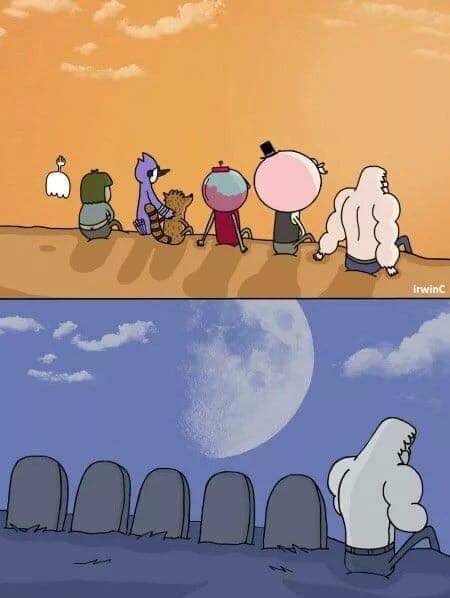
I wonder if something similar happened to early Internet folks, this grief for the future that didn’t happen. Did they get angry when they realized RSS feeds didn’t pan out? When the Internet bubble burst because someone tried to put Radio on the Internet? That the Internet got bundled into a few datacenters we call the Cloud™️ rather than run on a million home servers?
I take solace in thinking the Internet happened over 60 years, and then all of a sudden. Arnaud linked a 1979 memo by an early Apple employee taking a cold hard look at what it’ll take for the dream of a computer world to actually happen.
Indeed, it sounds ludicrous. It was both way easier (we don’t use discs to share data, we have a neat thing called “the Internet”) and way trickier (yep, the social fabric has indeed been crumpled a bit and software engineering is still hard) than anyone had anticipated.
Sometimes, it just takes time.
On that note, I thought about the XKCD comic Tasks recently.
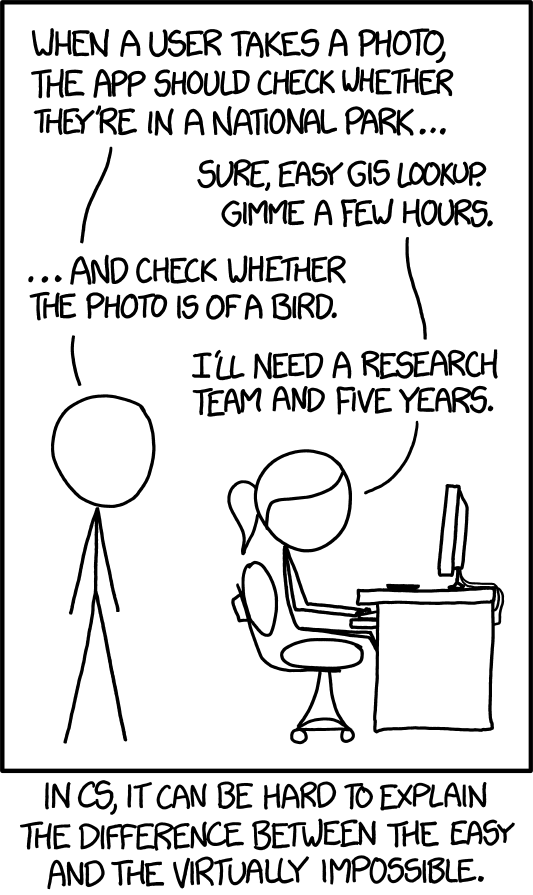
It was published in 2014-09-24, more than ten years ago. And, indeed, it took in the ballpark of “a research team and five years” to achieve what seems “virtually impossible” in the comic, and about x1000 that to get to LLMs. But, in the end, it did happen. We’ve built something that passes the Turing test, that writes code faster than humans, that can talk, respond, generate images, and believable videos of Will Smith eating.
Sometimes, it just takes time.
I got into blockchain because it was the coolest thing in the world at the time. Programs that you can trust running on a computer that doesn’t stop. It still feels like the future, even if AI has come out of its decades-long winter and stolen the crown for “hottest piece of tech to sacrifice your 20s to.”
I’m still in the trenches. I still feel like today’s not the end of history for blockchains.
Sometimes, it just takes time.